
What is CSR and why is it important for your organization?
CSR stands for corporate social responsibility. This means that as an organization you don't just look at financial results, but also at the impact of your choices on people, the environment, and society. For many organizations, sustainable mobility is one of the most concrete ways to put this into practice.
On this page you'll find out what CSR is, what the three pillars are, and how mobility contributes to your CSR policy.


Rick Homan, Product Owner Strategisch Accountmanagement
NS Zakelijk
CSR stands for corporate social responsibility.
CSR is about finding the right balance between people, planet, and profit.
Sustainable mobility helps organizations turn CSR goals into something concrete.
Legislation such as the CO2 reporting obligation and the CSRD is making sustainability increasingly important.
With NS Zakelijk you gain insight into mobility and steer toward CO2 reduction.
What does CSR mean?
Corporate social responsibility (CSR) means that as an organization you look beyond financial results alone. You take into account the consequences of your choices for employees, customers, society, and the environment.
CSR is about finding a healthy balance between economic growth, social responsibility, and the sustainable use of natural resources. That's why CSR is often explained using three pillars: people, planet, and profit.
By making CSR part of your business strategy, you work not only toward a more sustainable organization, but also toward a future-proof business.
The three pillars of CSR
The people pillar is about the people within and outside your organization. Think of good working conditions, attention to vitality, diversity, and equal opportunities. Organizations that invest in their employees build engagement, sustainable employability, and an attractive work environment.
The planet pillar focuses on reducing environmental impact. Think of CO2 reduction, a circular economy, and conscious choices around energy and resource use.
For many organizations, mobility is one of the fastest ways to lower CO2 emissions. By encouraging employees to travel by train more often, or by promoting other sustainable transport choices, you contribute directly to your organization's sustainability goals.
Profit is about a financially healthy organization that can keep investing in innovation, employment, and sustainable growth. Sustainable choices go hand in hand with good business practice here.


CSR only really gains value when you translate it into daily practice. Many organizations start with practical measures, such as circular procurement, switching to green energy, reducing waste streams, or greater transparency in the supply chain.
Sustainable mobility is also a concrete example of corporate social responsibility. By encouraging employees to travel by train more often, or by promoting other sustainable transport choices, you reduce the CO2 emissions of commuting and business travel. This way you contribute directly to the planet pillar of CSR, while also making mobility more efficient and easier to manage.
That depends on your organization. Depending on size and activities, organizations may be subject to CO2 reporting, the CSRD, and due diligence requirements. Even if these rules don't apply to your organization, customers, suppliers, and other supply chain partners are increasingly expecting insight into sustainability.

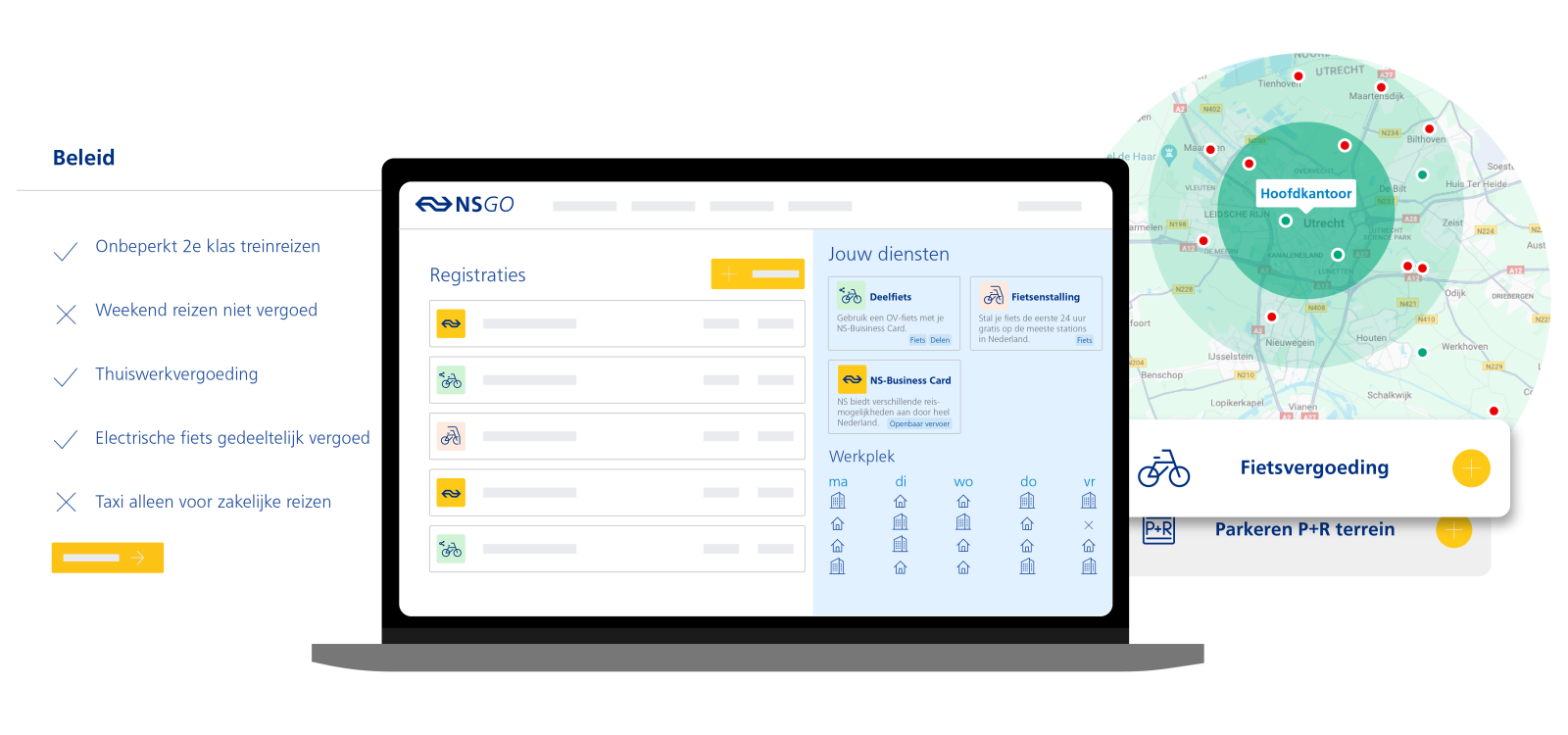
Sustainable mobility is a practical way to give substance to your CSR policy. If you have insight into travel behavior and CO2 emissions, you can steer toward more sustainable choices and more easily meet reporting obligations.
With
Frequently asked questions about CSR
Is CSR mandatory for every company?
For many organizations, CSR is still voluntary. Even so, more and more companies are facing legislation and regulation around sustainability, such as the CSRD and the CO2 reporting obligation. Customers, suppliers, and other supply chain partners are also increasingly asking for insight into the social and environmental impact of organizations.
What does CSR cover?
CSR covers all the choices through which you, as an organization, take people, the environment, and society into account. Think of good employership, circular procurement, CO2 reduction, sustainable mobility, diversity and inclusion, responsible supply chain management, and transparency about sustainability goals.
Why is mobility important within CSR?
For many organizations, mobility is one of the most concrete ways to put CSR into practice. By encouraging employees to travel by train more often, or by promoting other sustainable transport choices, you lower the CO2 emissions of commuting and business travel. Mobility data also helps you develop more sustainable policy and report more easily on your sustainability goals.
What are the characteristics of CSR?
CSR is an integral part of business strategy. Organizations take into account the interests of employees, customers, suppliers, and society. Transparency, measurability, continuous improvement, and a balance between people, planet, and profit are key characteristics of corporate social responsibility.
What are the principles of CSR?
The key principles of CSR are taking responsibility for your organization's impact, being transparent about your approach and results, acting ethically, and taking stakeholders' interests into account. These principles align with the international guideline ISO 26000.