
Mobility budget: what is it and how does it work?
More and more employers are switching to a mobility budget. It's more flexible than a lease car and fits better with hybrid working.
A mobility budget is a fixed amount that employees spend themselves on commuting. You set the budget, they decide how they travel. That gives a lot of freedom, but it also raises a question: how do you keep track of what employees spend and how sustainably they travel? A mobility platform can help with that. With NS Go you manage public transport, shared mobility, and automatic processing in one place, with 24/7 insight into costs and CO2 emissions. Less administration, more overview.


Mark Sloothaak, Mobiliteitsadviseur
NS Zakelijk
A mobility budget is a fixed amount that employees use to cover their commuting and business travel expenses.
Employees choose their own mode of transportation: public transportation, bicycle, car-sharing, or their own car.
There is no legal maximum, but tax rules apply under the work-related expenses scheme (WKR). A mobility budget is often more flexible than a leased car and is better suited to hybrid work arrangements.
NS Zakelijk helps you with the implementation, from policy to systems such as NS Go.
What is a mobility budget?
A mobility budget is a fixed amount per month or per year that employees use for their commuting and business travel. They select the mode o transport that suits their situation, while you set the budget and conditions. Employees can choose from:
Public transport, such as an NS season ticket or single tickets
A bicycle or shared bike
A shared car or carpool
Their own car
The mobility budget serves as an alternative to both the traditional company car and a fixed mileage allowance.
Benefits of a mobility budget for employers
Employees no longer have a fixed company car but a mobility scheme that matches how they actually travel. They appreciate this, and it makes you a more attractive employer.
You set the budget in advance. There are no unexpected lease invoices or rising fuel costs. This saves money since a company car still costs you when it is not used: you pay ongoing lease and depreciation fees. Additionally, from 1 January 2027, the pseudo final levy on (fossil fuel) company cars will apply, increasing costs even further. Read more about the
A mobility budget encourages environmentally friendly travel options. This contributes to your organisation’s CO₂ targets and demonstrates your commitment to sustainable business practices.
Job seekers increasingly prefer employers who offer hybrid working options and a flexible mobility allowance. This gives you a strategic advantage in attracting and retaining staff.
No lease contracts, no vehicle insurance. Less paperwork, more clarity.
Benefits for employees
Employees choose the mode of transport that works best each day, whether they're in the office or working from home. This way, their travel always matches that day's plans.
Does an employee travel more cheaply than the available budget? Then they keep the difference, net. That's a direct incentive to make cost-conscious choices, for example taking the train or bike more often.
If an employee doesn't choose a lease car, they also don't pay a taxable addition (bijtelling). That makes a real difference net, compared to a company car. Whether employees have this choice is something you decide yourself in the terms of the mobility budget.


There's no separate law for the mobility budget. The regular tax rules from the Dutch Tax Administration (Belastingdienst) apply, just as they do for other allowances and benefits. This means you have relatively broad freedom as an employer, as long as you stay within the existing rules for tax-free allowances and the work-related costs scheme.
There is no legal maximum; as an employer, you decide the budget amount.
You will reimburse employees, retroactively from 1 January 2026, up to €0.25 per kilometre tax-free for commuting and business trips, regardless of the mode of transport.
If you reimburse more than the tax-free limit, the excess falls under the free space of the work-related expenses scheme (WKR).
Calculating gross to net mobility budget
With a gross budget, payroll tax is still deducted, so an employee ends up with less than the assigned amount. With a net budget, you set the amount after tax, so the employee can spend the full amount. This difference ultimately determines what an employee actually keeps.
How much an employee keeps net depends on their choice of transport. If they use their own car, part of the budget is tax-free, and the rest is not.
Example calculation
€800 budget, 1,000 km commuting per month by own car:
Component | Calculation | Amount |
Tax-free kilometre allowance | 1,000 km × €0.25 | €250 tax-free |
Remaining budget (gross) | €800 − €250 | €550 gross |
Net of €550 (tax rate 36.97%) | €550 × 63.03% | approx. €347 net |
Total net amount received | approx. €597 net |
Note:
The tax rate used (36.97%) is indicative. The actual rate varies per person and year.
Employees still pay their own travel costs, such as fuel and maintenance, from the net amount.
If the employee chooses the train, you can often reimburse the public transport season ticket tax-free. This means they keep more with the same budget.

Step 1: Set measurable goals
What do you want to achieve? Consider lower CO₂ emissions, reduced costs or happier employees. Clear goals will help you evaluate the results later.
Step 2: Involve employees early
Ask for their input. This encourages everyone to contribute and lets employees share their own preferences.
Step 3: Analyse travel patterns
How do employees travel now and what do they need? Tailor the mobility budget to actual transport requirements.
Step 4: Seek advice
Consult a tax advisor about fiscal rules. NS Zakelijk can support you with your mobility and sustainability goals.

Step 5: Develop a policy and communication plan
Create a policy or adjust your existing mobility policy. Inform all involved about the changes and benefits. Make sure employees know how to make the most of the budget.
Step 6: Provide the right systems
Arrange the tools to manage the mobility budget and connect them to your existing HR and travel expense policies.
Step 7: Keep evaluating
Set KPIs and regularly review progress. Adjust the plan if the situation requires it.
If you want to start using a mobility budget but do not know where to begin, we are happy to help and advise you.

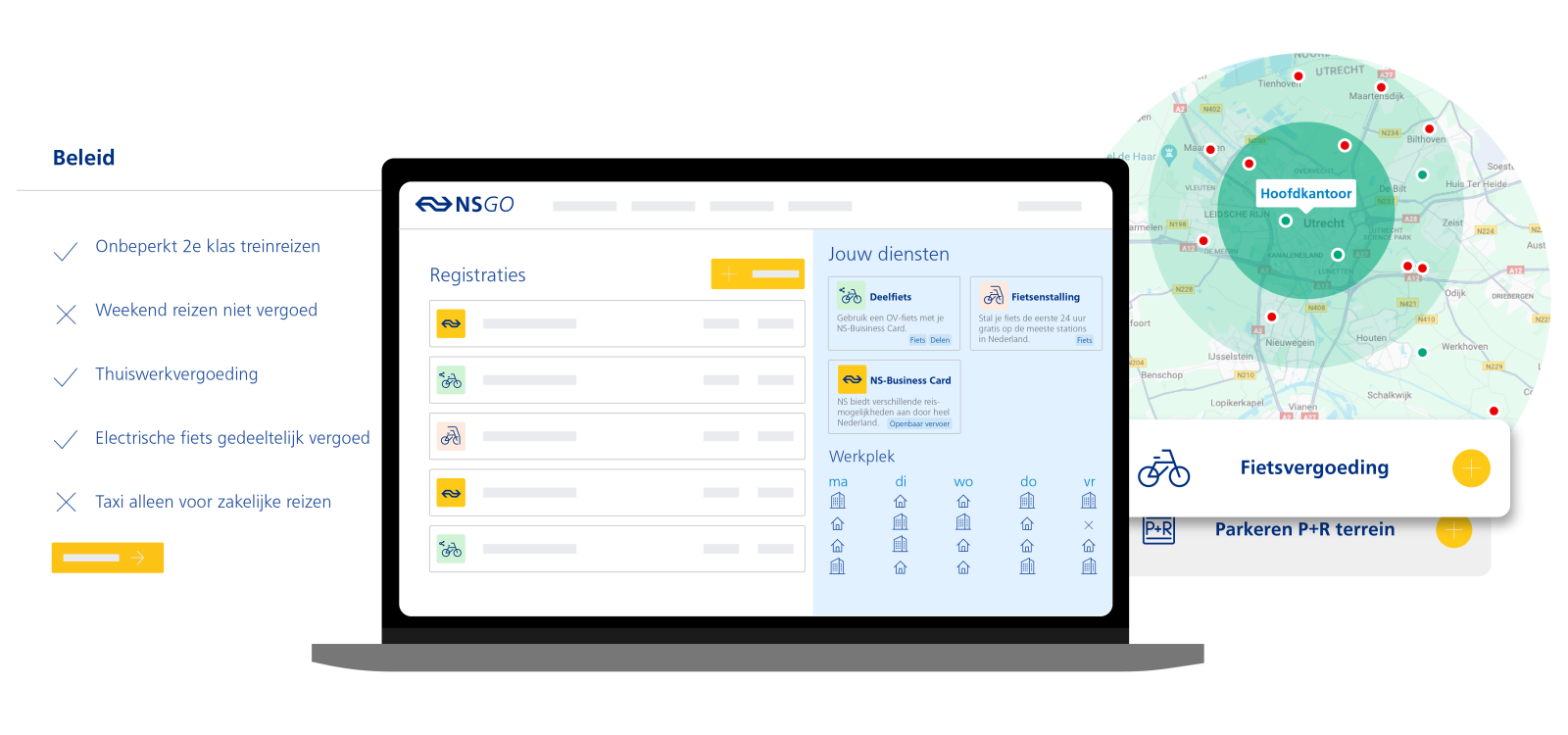
Manage your employees' mobility budget on one NS Go platform. From public transport and shared mobility to automatic processing with your HR systems, it's all bundled in one place. Employees register their trips automatically, giving you 24/7 insight into costs and CO2 emissions, without separate invoices or manual processing. This saves you time on administration and gives you a firm grip on your mobility budget.
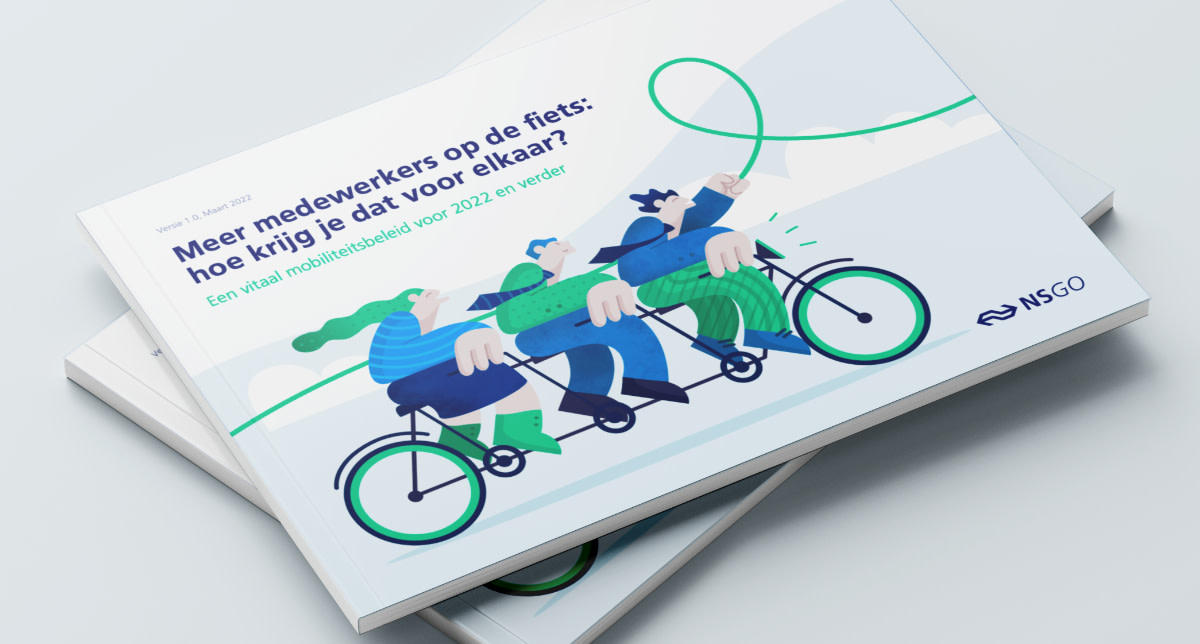
How do you create an attractive cycling policy that fits perfectly within your mobility policy? Discover the answer in the whitepaper (in Dutch).

Frequently asked questions about the mobility budget
What is the difference between a travel allowance and a mobility budget?
A travel allowance is a fixed amount per kilometre or a set monthly payment. You decide the amount, and the employee has no choice in how to use it.
A mobility budget works differently: the employee chooses their mode of transport. Whether by train, bike, shared car or private car, as long as it fits within the budget. This offers more flexibility, especially with hybrid working. Employees who spend less than their budget keep the difference.
Is offering a mobility budget mandatory?
No, a mobility budget is not legally required. As an employer, you are free to decide how to reimburse travel expenses. Collective labour agreements or employment contracts may impose restrictions. Always check the agreements that apply within your organisation.
Are you considering introducing a mobility budget? NS Zakelijk can support you from the first steps to setting up the right systems. Would you like to know more?
What are the drawbacks of a mobility budget?
A mobility budget requires employees to take more personal responsibility. For those who travel long distances, a lease car can sometimes be more advantageous: the employee always has a car available and knows exactly what to expect. Implementing a mobility budget also needs more preparation time than a standard lease arrangement. However, when set up properly, it involves less operational administration than managing a fleet or lease process.
Which is better: a lease car or a mobility budget?
That depends on the situation. If an employee drives a lot and values a car as a benefit, a lease car is suitable. For someone working hybrid and travelling irregularly, a mobility budget offers more: no additional tax charges, greater flexibility and less administration. You set a fixed budget in advance and manage everything on one platform, without separate lease contracts or vehicle insurance.
Can I combine a mobility budget with a lease car?
Yes, you can. Some employers provide a lease car for long business trips and a mobility budget for commuting. Make sure the employee is not reimbursed twice for the same journey under both schemes. Bear in mind that a lease car has ongoing costs, even when not in use. An NS train subscription can be a good alternative for many employees. If you have any questions, please contact us.