
Mobility in healthcare: the balance between legislation, collective labor agreements, and sustainability
Enough parking space for colleagues, patients, and visitors, compliance with laws and regulations, collective labor agreement requirements, and the ambition to become more sustainable. Organizing mobility within your hospital or healthcare institution and finding the right balance among all these demands and interests is a complex task. That’s why we are happy to collaborate with you on a mobility policy that not only meets all the rules but also fits your practice and ambitions for the future.


Jeroen Meijer, Sales Manager
NS Zakelijk
The Green Deal Sustainable Healthcare as a guideline
With the ‘Green Deal Sustainable Healthcare,’ your healthcare organization is also committed to significantly reducing CO2 emissions: 55% less by 2030 and climate neutrality by 2050. There is also an interim target of a 30% reduction by 2026. To achieve these goals, agreements have been made, including promoting sustainable commuting for employees and phasing out fossil fuel cars.
The Collective Labor Agreement also sets clear requirements
The collective labor agreement (CAO) for hospitals now considers travel time between multiple locations as working time. It is therefore important that this time can be used effectively. The CAO for academic hospitals goes even further, offering 100% public transport reimbursement for commuting distances over 7 kilometers, as well as mileage allowances for cycling and walking, plus an attractive bike scheme to encourage sustainable travel.


Besides all the requirements, a sustainable mobility policy also contributes to the satisfaction and well-being of your colleagues. We understand that not all employees are the same. Office staff and day shift workers usually travel well by public transport. However, for colleagues working evening and night shifts, a car often remains indispensable. Your mobility policy can address these differences per employee group.
Less traffic and parking stress, shorter travel times, more personal time during travel, and contributing to a healthier world. These are small things that can make a big difference. The advantages of traveling by public transport compared to car travel are becoming increasingly significant. And when you look at the generation of professionals choosing healthcare now and in the future, a sustainable mobility policy is also an important factor in attracting and retaining talent.
Want to know more about the role of sustainability in talent retention?
How do you get started with a sustainable mobility policy? We always advise starting with insight. How do your employees currently travel? Who mainly uses the car, who can easily use public transport, and who benefits from shared mobility? And where are the opportunities to make employees’ travel behavior greener? With a mobility survey, we map this out together, so you know exactly where the improvement and action points are. What works for an office worker is very different from what works for a doctor or nurse on the night shift. There are no black-and-white solutions; it’s mainly about making conscious travel choices.

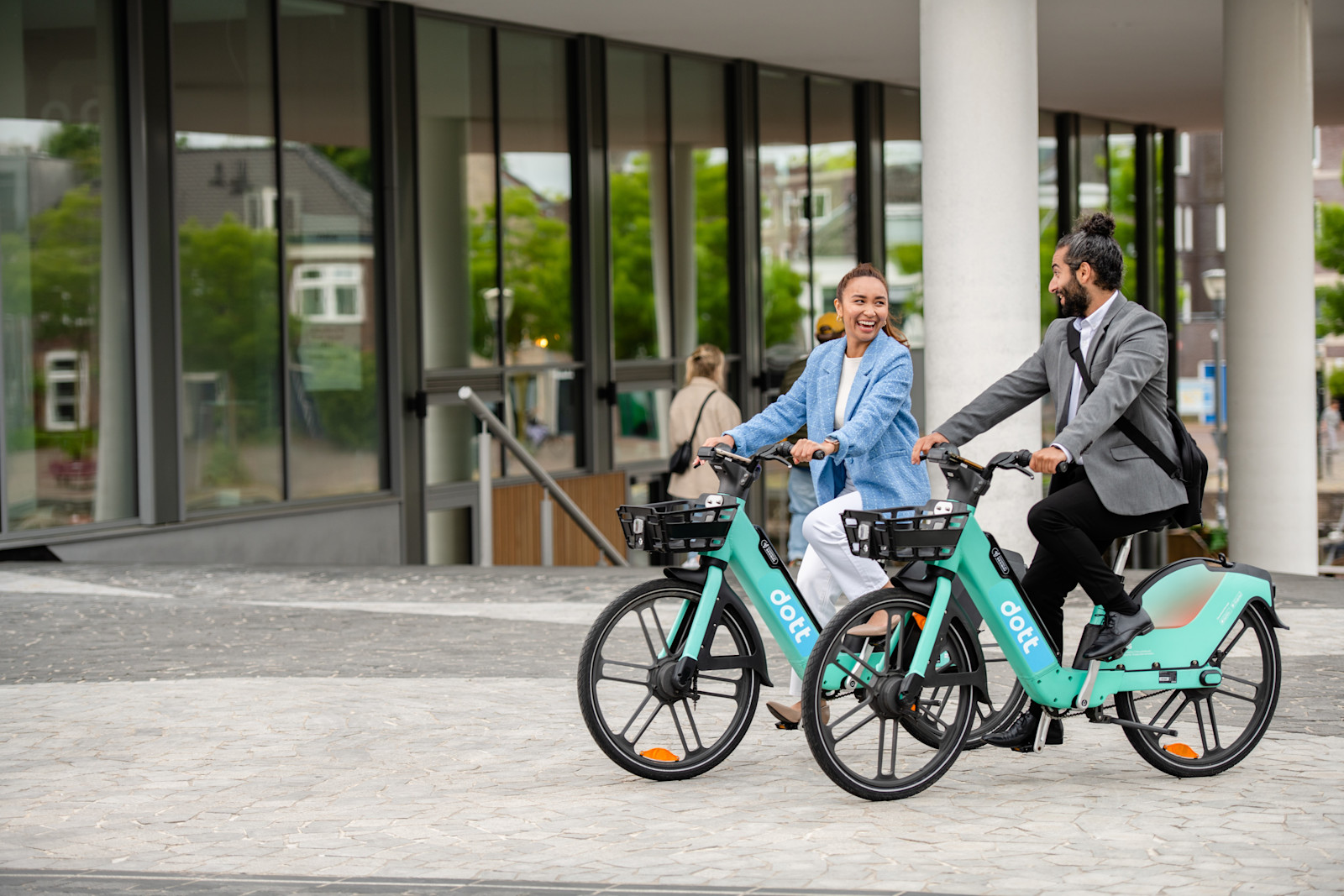
Next, we translate the insights and improvement points into a mobility vision that suits your organization. This vision serves as the moral compass for all the measures you take. It also helps explain to your employees the reasons behind certain changes. A mix of steering and enticing often works best. Enticing means making sustainable travel attractive and easy, for example with higher reimbursements for cycling and public transport kilometers, bike plans, shared cars, and electric shared bikes on location, and good facilities for working from home. Examples of steering measures include lowering car allowances, limiting parking rights for employees who live nearby, introducing paid parking, and requiring at least one work-from-home day per week for office employees.
In the whitepaper ‘Duurzame mobiliteit in de zorg: zo doe je dat', we explain how to transition to a more sustainable mobility policy in three steps. We share practical tips and examples, as well as ways to change your employees’ travel behavior.


Our solutions
Would you like to start working on sustainable mobility as a hospital or healthcare institution? We are happy to work together with you to develop a mobility policy that works for your organization and meets the requirements. We offer knowledge and products that fully support you.
Prefer advice or have a question? Let us know, and we will get back to you promptly.
This is our mobility card that allows your employees to travel flexibly and sustainably. By train, bus, tram, and metro, but also shared transport such as the OV-bike, Check scooters, and Greenwheels cars—all on one invoice, easy for them and clear for you.
Our smart mobility platform collects all travel data from your employees automatically via the NS-Business Card and additionally by adding their own transport data. This provides clarity, insight, and helps you comply with CO2 reporting.
Would you like advice on setting up a sustainable mobility policy? Or do you have a question about the NS-Business Card, want a mobility survey, or a demonstration of NS Go? We’re here to help.
Click the button, fill in your details, and we will call you back shortly.