Travel allowance 2026: everything employers need to know
In 2026 you may reimburse employees up to € 0,25 per kilometre tax-free for commuting and business travel. There is an exception for public transport: you may reimburse the actual public transport costs entirely tax-free.
In this article you will read which rules apply to the travel allowance, when a reimbursement is required, which reimbursements are tax-free and how you as an employer can manage commuting, business travel and hybrid working smartly. You will also discover how the NS-Business Card and NS Go help to manage travel costs easily.


Mark Sloothaak, Mobiliteitsadviseur
NS Zakelijk
For journeys using private transport, such as on foot, by car or by bicycle, a maximum tax-free mileage allowance of €0.25 per kilometre applies in 2026.
For public transport that kilometre limit does not apply: you may reimburse the actual public‑transport costs fully tax‑free.
A travel allowance is not legally required, unless agreed in a collective labour agreement (cao) or employment contract.
Additional rules apply for fixed travel allowances and home‑working allowances when working hybrid.
With the NS‑Business Card and NS Go you can manage travel costs easily and keep control of travel behaviour and mobility costs.
What is a travel allowance?
A travel allowance is a contribution from the employer towards the costs of commuting and business travel. You can choose a per‑kilometre allowance, reimbursement of actual public‑transport costs, a mobility budget, or a corporate mobility card.
How much travel allowance may you give tax‑free?
The tax‑free treshold: €0.25 per kilometre
For journeys on foot, by bicycle, car or motorbike you may reimburse up to € 0,25 per kilometre tax-free in 2026. If you reimburse more, the excess counts as taxable pay unless you use the available space in the werkkostenregeling (WKR). For public transport, it works differently. You may reimburse the actual public transport costs entirely tax-free, even if they are higher than € 0,25 per kilometre.
Want to know more? Read the rules on the maximum tax‑free kilometre allowance on
Read our article on calculating travel allowance. There you will find the formula, worked examples and an explanation of fixed and flexible travel allowances.



For journeys by train, metro, tram and bus there is an exception to the kilometre allowance. Instead of the maximum € 0,25 per kilometre, you may reimburse the actual public transport costs entirely tax-free.
This is an important difference compared with private transport. For journeys by car the maximum tax-free reimbursement is € 0,25 per kilometre. If the actual costs are higher, for example because of fuel, parking or lease costs, the excess is in principle taxable.
You can offer or reimburse a season ticket or a 1st class journey tax-free under certain conditions. That is possible if the season ticket is also used for commuting or business travel.
You do not have to record for each individual journey whether it was business or private. As long as you as an employer can show that the season ticket is also used for business travel, you can offer or reimburse it tax-free. This means travelling by public transport is not only tax-advantageous but also simpler to administer.
Pre- and post-station kilometres
Do you reimburse your employees’ public transport travel costs? You cannot then give an additional tax-free kilometre allowance for the same trip. You can, however, reimburse certain costs tax-free for the part of the journey to and from the station. This supports employees for part of their door-to-door journey. This pre- and post-station journey consists of the distance an employee travels to reach the station or from the station to the final destination. That can be on foot, by bicycle or by car. For these kilometres you may reimburse up to € 0,25 per kilometre tax-free. Parking costs at a Park and Ride (P+R) location can also be reimbursed tax-free under conditions if they relate to commuting or a business journey.
How do you arrange a travel allowance for hybrid working?
Hybrid working also changes the way you reimburse travel costs. Do you opt for a fixed or a flexible allowance? And how do you keep the administration clear? Below you can read about the main options.
Do you give a fixed monthly travel allowance? You may calculate this based on 214 working days a year, provided an employee travels to the same fixed workplace for at least 128 days a year. You apply this pro rata for part-time employees. If an employee travels less often, a flexible allowance is often more suitable.
A flexible travel allowance aligns with employees' actual travel behaviour. It is especially useful when employees alternate between working from home and at the office.
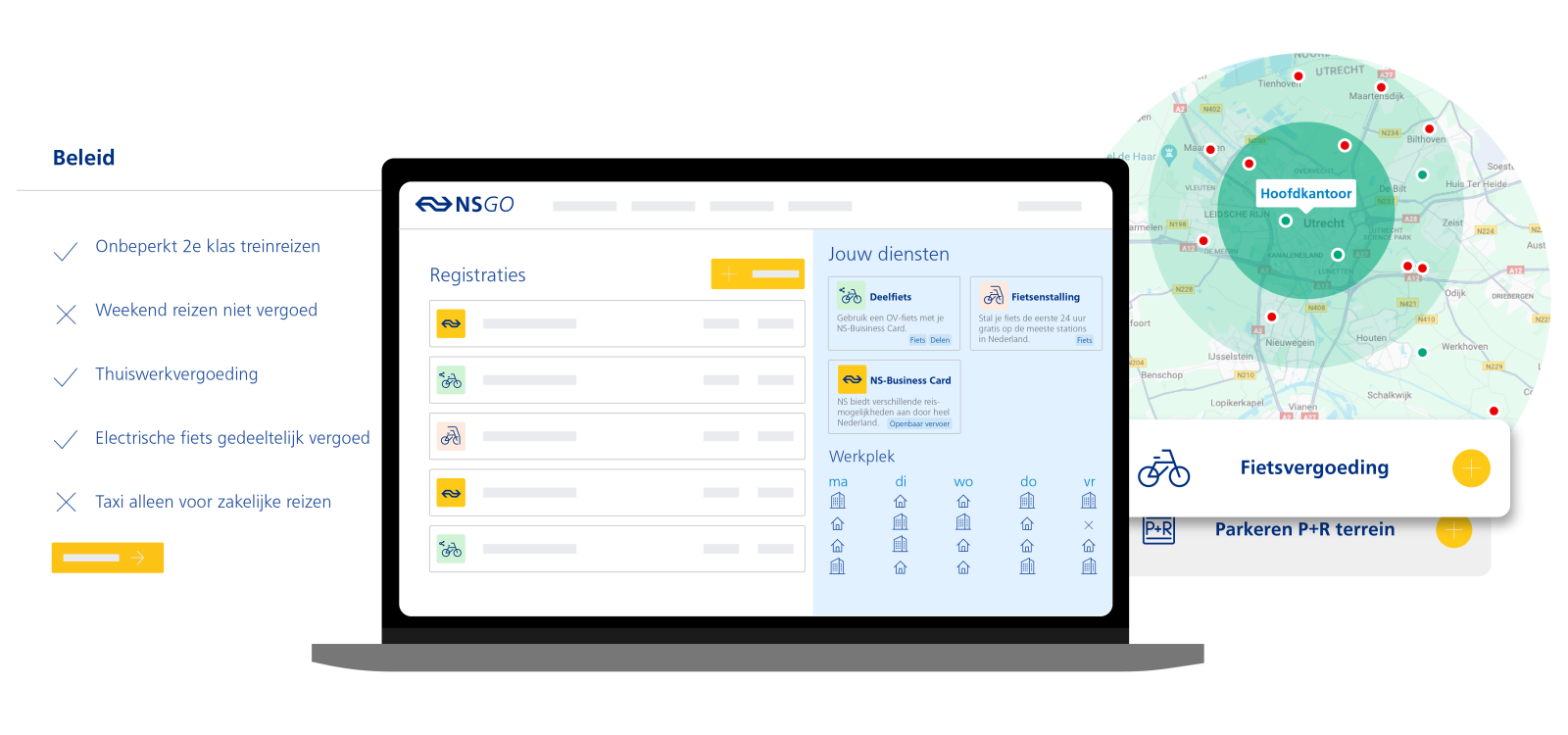
Do you use different allowances for each mode of transport, for example for the bicycle, car or public transport? With NS Go you register and process these allowances automatically. This reduces administrative work, lowers the risk of errors and helps you to process allowances easily.

Do you use a work-from-home allowance and a travel allowance? Specific tax rules apply.
The main rule: on each working day give either a tax-free work-from-home allowance or a tax-free travel allowance for commuting. You may not combine these allowances on the same day.
Exception: if an employee makes a business trip on a work-from-home day, you may, in addition to the work-from-home allowance, give a tax-free allowance of € 0,25 per business kilometre.
If an employee travels that day to the fixed workplace with a season ticket paid for by you or with a company bicycle, you may not give a tax-free work-from-home allowance for that day.

No. As an employer you are not required to give a travel allowance. This is only mandatory if agreements have been made about it in a collective labour agreement, employment contract or staff handbook.
Tip: always record agreements about travel allowances clearly. That way employees know what they are entitled to and you avoid uncertainty about reimbursements for commuting and business travel.

There is no statutory minimum distance for a travel allowance. As an employer you decide from which distance employees receive an allowance.
Do you want to encourage sustainable transport? You can choose not to apply any distance threshold. You can also offer higher kilometre reimbursements for journeys by bicycle and lower reimbursements for car kilometres. This makes sustainable travel choices more attractive for employees.
Bear in mind that a kilometre allowance above € 0,25 per kilometre is taxable. If you reimburse, for example, € 0,40 per bicycle kilometre, a maximum of € 0,25 per kilometre is tax-free. The amount above that counts as taxable pay unless you allocate it to the free space in the werkkostenregeling (WKR) under the applicable conditions. If free space is still available you can include the excess there. If the free space is fully used, you pay an 80% final levy on the excess.
Hybrid working makes managing travel costs more complex. With the NS-Business Card and NS Go, journeys are registered automatically, allowances are processed and linked to your HR and payroll system. That way you keep control of travel behaviour, mobility costs and the administration.