NS sales process for rolling stock
(1) This note sets out the process that NV Nederlandse Spoorwegen (“NS”) will follow when any of its group companies sell rolling stock to third parties. NS has adopted this process as its policy for the sale of rolling stock that is withdrawn from service in accordance with its fleet plan.1 NS has published this note on its website.2
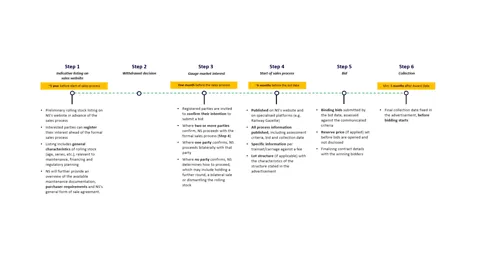
(2) The note follows the key moments of the process, from listing to collection. In general, NS identifies six steps in the sales process.
(3) The process is designed so that from the moment of listing, an interested party has ample time to arrange financing, investigate homologation and stabling facilities, identify a maintenance provider and organise transport.
- A series (or part thereof) is listed (Step 1) approximately one year before the sales process is expected to start.
- The bidding period of approximately six months runs from the moment the sale is advertised (Step 4). Bidders are informed of the outcome of the sales process shortly after the bid date.
- The purchaser has at least three months after the award to collect the rolling stock, including transfer of ownership (Step 6)
(4) NS may apply shorter timelines than indicated above in exceptional circumstances (e.g. a pandemic, regulatory changes requiring earlier withdrawal from service, or urgent stabling capacity constraints) or where a registered party submits an unsolicited bid for all or a substantial part of the offered rolling stock, or an unsolicited bid at a price above the expected value, before the formal sales process has started.
Step 1: Listing on the sales website
(5) Approximately one year before the sales process(es) for the rolling stock is expected to start, NS publishes the intended sale on its sales website, which will be maintained/updated throughout the sales process(es).3 From this moment, interested parties can register. The listing provides:
- The rolling stock series and the indicative number of units
- The indicative dates of the sales process and collection
- The age of the rolling stock
- The main technical specification of the series, including the area(s) or country(ies) for which the rolling stock is homologated
- An overview of the available maintenance documentation that will be made available
- The requirements NS will impose on a purchaser, including the designation of a vehicle keeper and of an Entity in Charge of Maintenance (ECM), and financial capacity
- The general sale agreement used by NS, which includes the obligation that the rolling stock must be used for railway operations after the sale
(6) Dates and numbers are indicative as withdrawal from service may be postponed, for instance where operational circumstances require it. However, the published dates on the sales website are the earliest dates on which the sales process may start.4
Note: On the basis of this information, a prospective purchaser can establish whether it is able to operate and maintain this type of rolling stock, approach maintenance providers and arrange financing. After the rolling stock is withdrawn from service, additional information will become available (e.g. the condition of the individual units). This will be added to the information package, which will be available for a limited fee (see Step 4).
Step 2: Withdrawal from service
(7) Rolling stock that NS withdraws from service falls into two categories: (i) series (or parts thereof) withdrawn in accordance with the fleet plan, and (ii) units withdrawn because they are damaged or, for technical reasons, no longer fit for further use. This process applies to the first category.
(8) Where the NS fleet plan shows that a series (or part thereof) has no foreseeable future in NS's operations and if the sale of the rolling stock is not prohibited by European regulations, NS will offer it for sale in accordance with this process. NS will apply this as an internal rule governing the assessment of each series under the fleet plan. Which series are offered for sale is visible on the website. NS will only dismantle a rolling stock series (or part thereof) where a sales process has not resulted in a completed sale.
Step 3: Gauging the interest of the market
(9) Shortly before NS advertises the start of the formal sales process, it will invite the registered parties to indicate whether they intend to submit a bid. At that moment, registered parties will have had approximately one year since the listing to prepare their position.
(10) Where two or more parties express an interest in submitting a bid, NS proceeds with the formal sales process as described in Step 4. Where only one party expresses an interest, NS may enter into a bilateral negotiation with that party. Where no party expresses an interest, NS may hold a further round at a later date or dismantle the rolling stock.
Note: The purpose of this step is to match the process to the level of market interest. Where multiple parties are interested, a formal competitive process serves the market and NS's own interest in obtaining the best price. Where only one party (or none) has come forward after a year of availability, a multi-month extensive bidding process would add time and cost without serving those objectives. Adjusting the process to the circumstances will normally mean the rolling stock enters the market more quickly, which benefits both the purchaser and the wider market.
Step 4: Start of the sales process
(11) If two or more of the registered parties express an interest in submitting a bid, the sales process starts with the publication of the advertisement. As part of the sales process, an information package will be made available to registered parties against a fee of EUR 1,000. The package includes information that only becomes available once the rolling stock has been withdrawn from service, such as the condition of the individual units, the history of technical defects, maintenance performed and wheel tyre diameters. The information package may be updated during the sales process.
(12) NS advertises the start of the sales process on its website and on specialised platforms for rolling stock (or adjacent materials), for instance, DB Gebrauchtzug, as well as in the specialised railway press, such as Railway Gazette and/or SpoorPro. The platforms used may differ depending on the type of rolling stock. NS assesses ahead of each sale what channels should be used. All parties that have registered an interest are notified when this step begins.
(13) The advertisement contains at least the following elements:
What is offered
- The series, the number of units
- The manufacturer, the years of construction and any modernisation
- The age and general condition of the units
- The lot sizes (if applicable)
Technical characteristics
- The current homologation, and any national (NL) requirements that may restrict use
- The principal technical characteristics e.g: maximum train composition, maximum speed, loading gauge, electrical systems, brake systems, train protection systems, and safety and control systems
- The configuration, dimensions, weight, traction motors and seating capacity per subtype
The process
- The bid date, which may be postponed during the sales process but will be set at least six months after the date of the advertisement
- The basis on which bids will be assessed, including how equal bids are resolved
- Whether a reserve price applies
- The latest date for collection, no earlier than three months after the date on which NS notifies the successful bidder (or, where the rolling stock is offered in multiple lots, the successful bidder for the relevant lot) that it has been awarded the sale (the “Award Date”)
- The opportunity to inspect the rolling stock
- The fee for the information package and how it is obtained
- The contact person at NS
Conditions of sale
- E.g. the rolling stock is sold as-is-where-is
(14) NS does not impose geographic restrictions on where within the European Economic Area the rolling stock is used after the sale, either in the selection of bidders or in the award. Collection takes place in the Netherlands, and the purchaser is responsible for onward transport from that point.
(15) NS supports prospective purchasers during the process as follows. Where questions from registered parties raise matters of general relevance, NS shares both the question and the answer with all registered parties. Where a purchaser reasonably requires assistance with knowledge transfer relating to the maintenance of the rolling stock or the technical documentation, NS is prepared to provide this within reasonable limits and on commercial terms to be agreed.
Note: The six-month bidding period, combined with the period between the listing and the advertisement, gives a prospective purchaser ample time to mobilise its technical, safety and financing teams, to prepare its bid and to engage a maintenance provider. The period is fixed for all interested parties. NS will normally not extend it, since an extension postpones the process for all bidders, including those that have organised themselves around the announced date.
NS decides per series whether the units are offered as a whole or in reasonably sized lots. That decision follows from how the units are composed, whether they can sensibly be split, and the number of separate transactions that would result, each of which has to be negotiated, documented and handed over.
Step 5: The bid
(16) Bids are submitted by the bid date determined by NS and assessed on the basis of the criteria communicated in the information package. NS informs bidders of the outcome shortly after the bid date.
(17) NS may apply a reserve price. The advertisement states whether a reserve price applies. Where a reserve price applies, it is set internally within NS before the bid date, it is not adjusted afterwards, and it is not disclosed externally. In case that no bid exceeds the reserve price, NS will hold a further round of sale or sell the rolling stock in an undisclosed bilateral process. If that further round or bilateral process does not result in an acceptable offer, NS may dismantle the rolling stock where it has an objective justification for doing so.5
(18) NS may postpone or discontinue a sales process. Registered parties are informed of any postponement or discontinuation. Where a process does not lead to a sale of a lot (e.g. because no bids are received), NS may hold a further round, or sell the rolling stock in an undisclosed bilateral process, or decide to dismantle it.
Step 6: Collection
(19) An indicative collection date is published in the listing and updated as the sales process progresses. The advertisement states the latest date for collection, which is never earlier than three months after the Award Date.
(20) Where the rolling stock has not been collected by that date, NS may charge the purchaser for late collection as set out in the sale agreement. Where the rolling stock remains uncollected after a further reasonable period, NS may terminate the sale agreement in accordance with its terms and offer the rolling stock for sale again or dismantle it. In a bilateral sale, NS may agree to a different collection period where its stabling capacity at that time allows.
Note: A prospective purchaser knows the indicative collection date from the listing and the final date from the advertisement, and can therefore arrange transport, stabling and homologation while the process is still running. NS never sets the collection date earlier than three months after the Award Date.
Withdrawn rolling stock occupies stabling capacity that NS needs for its own operations. An open-ended collection period would leave NS unable to plan that capacity, which is why the advertisement fixes a date.
1 Individual units sold for societal purposes (e.g. museums, police training) and individual units that are damaged or defective fall outside this process.
2 NS reserves the right to adjust elements of its sales process as set out below based on experiences with the adjusted sales process. Such changes will be published on the NS website.
3 For the avoidance of doubt: this sales process applies to the sale of rolling stock series or parts thereof. Individual units sold for societal purposes (e.g. museums, police training) and individual units that are damaged or defective fall outside this process.
4 Unless only one or none of the registered parties have expressed the intention to submit a bid (see Step 3).
5 An objective justification may exist, for example, where the rolling stock could only be transferred at a symbolic price, such that the transfer may amount to NS discarding waste within the meaning of Directive 2008/98/EC and would be subject to the applicable waste legislation.