History of NS
Today, you can easily catch a train to almost any destination in the Netherlands. But it was not always like this. The history of our railway begins with a simple yet brilliant invention: the steam engine. From that moment, everything moved very quickly—literally.
From steam and horses to rails and speed
Until the early 1800s, people mainly travelled on foot, by coach or by horse-drawn barge. That changed when Englishman James Watt developed the steam engine in 1765. In 1804, Richard Trevithick placed such an engine on rails. His primitive locomotive easily pulled heavy wagons. He did not yet realise how significant this invention would become.
In 1825, England opened its first railway line. In the Netherlands, there was still hesitation. Politicians, boatmen and farmers were concerned: would this new ‘iron monster’ cost jobs? Would livestock be frightened? And was 35 kilometres per hour not too fast for the human body? Despite this, development continued.
The first Dutch train
As Germany and Belgium expanded their railways, the Netherlands did not want to fall behind. King William I therefore decided that the country needed railways too. Thanks to government support, entrepreneurs were able to get started.
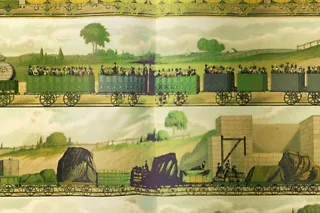
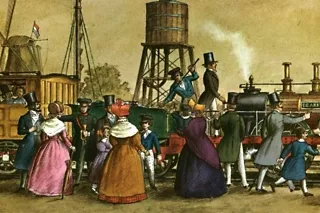
In 1837, the first railway company was established: the Hollandsche IJzeren Spoorweg Maatschappij (HIJSM). They built the line between Amsterdam and Haarlem, which opened in 1839. The first train was pulled by two locomotives with splendid names: De Arend and De Snelheid. A replica of De Arend is now on display at the Railway Museum.
A network that connects the Netherlands
Railway construction was slow until the government decided to build an extensive state railway network itself. The Maatschappij tot Exploitatie van Staatsspoorwegen (SS) managed much of these lines. By around 1900, most of the network as we know it today was already in place. Stations appeared everywhere, and for the first time, large groups of people could travel easily across the country.
War, cooperation and reconstruction
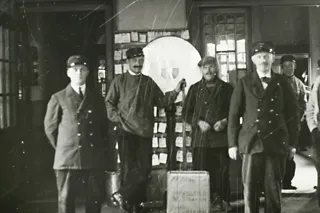
During the First World War, it became clear how important a well-organised railway system was. As a result, the SS and HSM began cooperating in 1917 under the name Nederlandse Spoorwegen (NS), though they remained separate companies.
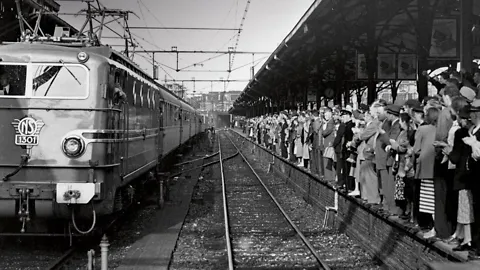
In 1937, the two companies officially merged into NS. Shortly afterwards, the Second World War broke out. The railway network suffered heavy damage: bridges were destroyed and many trains disappeared. After liberation, reconstruction began, supported by the Marshall Plan. The Netherlands took the lead in electrifying the railway, and in 1958 the last steam locomotive made its final journey.
The rise of the car and a new railway plan
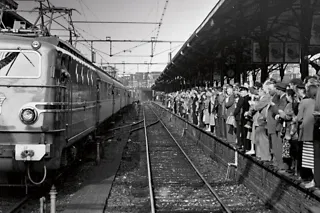
From the 1960s onwards, cars became increasingly popular. Many people chose their own transport, leading to a decline in train passengers. NS introduced new plans, such as Spoorslag ’70, a major timetable overhaul. Freight trains were also increasingly replaced by lorries.
In the 1980s, major developments were underway, including the HSL-Zuid and the Betuweroute. NS called for additional investment to prepare the railway for the future. At the same time, Europe was promoting more competition on the railways. This led to NS being corporatised in the 1990s and split into a commercial NS Group and organisations responsible for managing the tracks, which later became ProRail.
Corporatisation and focus on core tasks
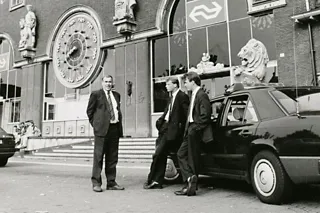
After corporatisation in 1995, NS took on a wide range of activities, including freight transport, track construction and telecom. Because competing in all these markets simultaneously proved difficult, non-rail activities were gradually phased out. The sale of telecom interests led to the creation of the NS One-Off Contribution Fund (FENS).
A modern NS: Focused on you
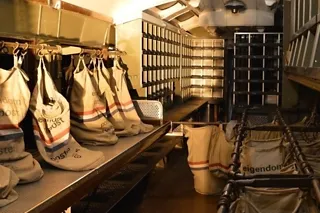
From 2000 onwards, NS decided to focus on what truly matters: passenger transport, train maintenance and improving stations. Quality needed to improve. NS invested in new rolling stock, better timetables and increased convenience for travellers.
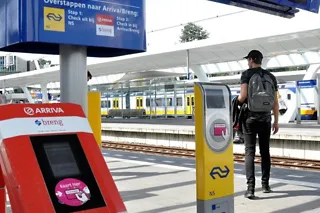
The OV-chipkaart, developed in collaboration with other transport providers, made travelling much easier. Safety was enhanced with gates at stations. The journey planner and later the app provided reliable travel information, although disruptions sometimes remained a challenge.
Meanwhile, door-to-door travel became more important. As a result, there were more OV-fietsen, better bicycle storage facilities and partnerships with organisations such as Greenwheels and Q-park. Major stations also evolved into modern meeting places where living, working and travelling come together.
And now?
NS continues to focus on reliability, sustainability and travel convenience. Train travel remains one of the most climate-friendly ways to get around, and NS is committed to maintaining this advantage. In addition, NS is expanding strong international connections, including routes to Paris, Brussels, London and Frankfurt.
If you want to explore the history even further, you can visit the Railway Museum, NVBS, the Netherlands Institute for Sound and Vision, or the Utrecht Archives. For now, remember: the train is not just a convenient means of transport, but a storybook on rails.