Green energy for trains, buses and stations
Since 2017, our trains in the Netherlands have run entirely on electricity purchased annually from renewable sources. NS was the first railway company worldwide to achieve this on a yearly basis. Since 2015, this has been done through Guarantees of Origin (GvOs) for wind energy, and from 2025 onwards, a combination of wind and solar power will be used.
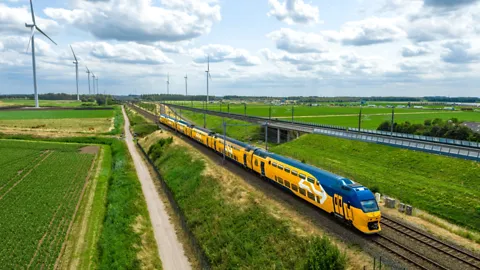
When you include the Guarantees of Origin (GvOs), the CO₂ emissions for a journey by train—including any replacement bus service—are effectively zero grams of CO₂ per passenger kilometre. For comparison, an average petrol car emits 195 grams of CO₂ per kilometre, and an electric car still emits 62 grams of CO₂ per kilometre due to electricity generation.
Physically, however, our trains run on the Dutch electricity grid, which still includes some fossil fuels. Calculating emissions based on the actual electricity mix (without GvOs) shows that CO₂ is still released during power generation.
Considering all processes within NS and the full supply chain, the total CO₂ emissions for travel with NS amount to 44 grams per passenger kilometre. This means the train remains one of the most climate-friendly ways to travel in the Netherlands—after walking and cycling—especially compared to car or air travel.
What else does NS do?
When trains cannot run, NS deploys buses that have been operating on HVO (Hydrotreated Vegetable Oil) since 2019. This fuel is made from used frying oil and industrial fats and reduces CO₂ emissions to one tenth of those from diesel.
Stations are heated using heat-cold storage systems, green electricity or gas. We also aim to use more of our own resources, such as buildings and land, to generate sustainable energy.